
Academic Papers Finance & Economics
Timing of adaptation determines fiscal sustainability

By Massimiliano Tripodo
Published January 23, 2026
Slow adaptation raises inequality by about five Gini points and pushes joblessness up by as much as ten percentage points.
Main Results
Numerical simulations for Italy show that the timing of climate adaptation determines both the effect of climate change on economic resilience and fiscal sustainability. The study “Climate Adaptation and Fiscal Sustainability: When Timing Matters” by Nicola Campigotto introduces two adaptation strategies to explore potential solutions: Fast and Slow.
Front-loading adaptation (Fast) – 10 billion euros per year for three years. This approach limits climate-related GDP losses, stabilizes the tax base, and keeps the debt path close to a no-damage benchmark. Spreading the same 30 billion euros evenly over thirty years (Slow) yields only small gains: damages still cumulate, the tax take erodes, and public debt drifts upward.
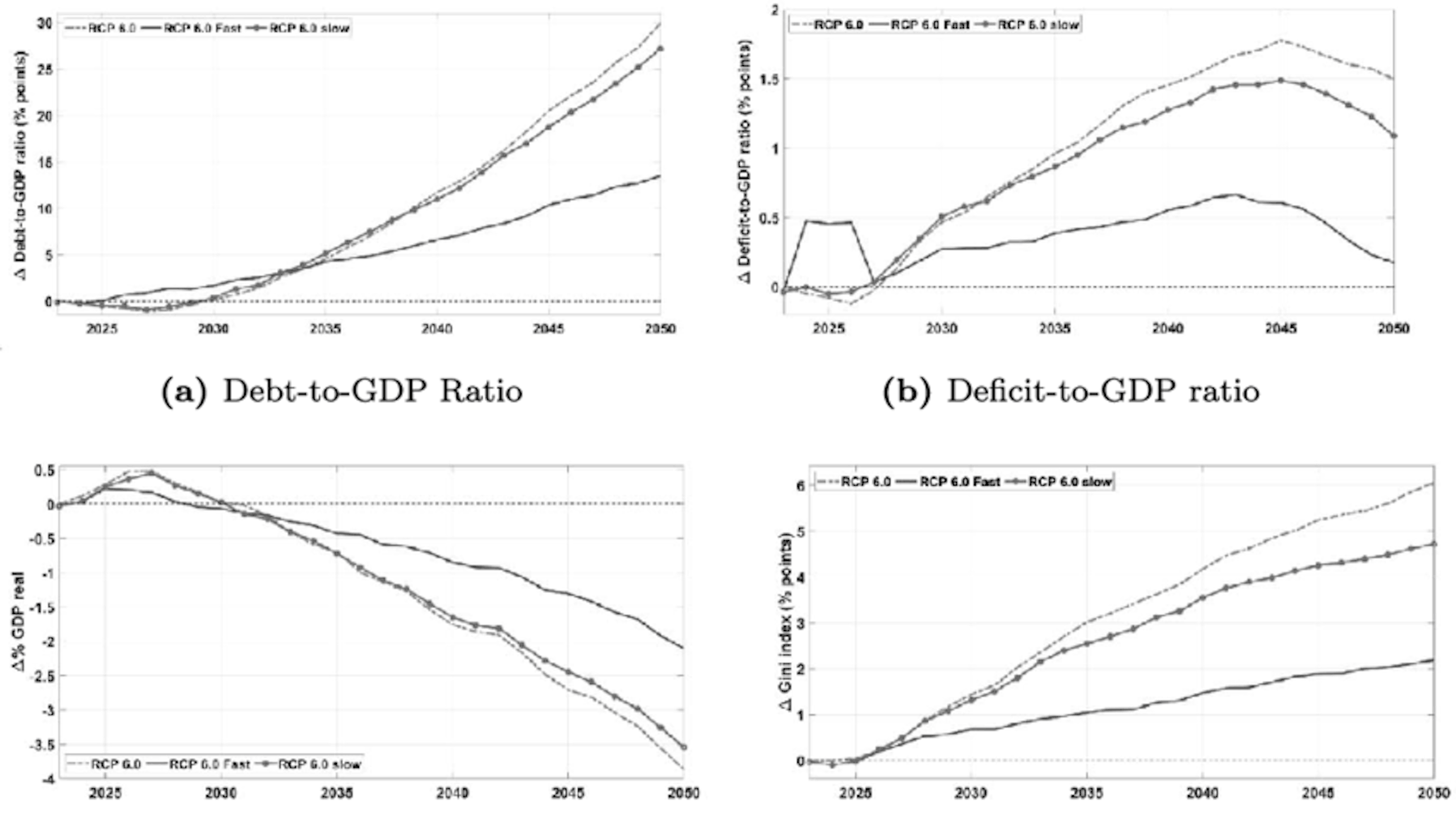
Under the damage scenario, differences emerge already in the early 2030s; by 2050 the debt-to-GDP ratio is roughly 30% higher than the benchmark in case of Slow adaptation, while stays near it in case of Fast adaptation. On public accounts, Fast intervention produces a short-lived deficit uptick (peaking around 0.5% of GDP) before stabilizing near 0.1–0.2%; Slow adaptation drifts toward ~1.5% above benchmark.
Distributional and labor-market outcomes also hinge on adaptation timing: Fast intervention contains inequality within ~2 Gini points and avoids sharp unemployment spikes, while Slow adaptation raises inequality by about five Gini points and pushes joblessness up by as much as ten percentage points by the end of the horizon.
Sectoral results are uneven. trade and agriculture see losses on the order of ~24% and ~14% in value added. Fast intervention better preserves the labor share, whereas Slow intervention induces a persistent decline.
A practical caveat: swift adaptation sustains activity and thus keeps emissions and energy use higher in case of slow intervention. In this sense, and for this reason, adaptation should be paired with mitigation.
Overall, fiscal austerity creates a lose-lose: it constrains the very climate adaptation spending that shields the economy, while letting damages accumulate and debt risks worsen.
Background
The study probes whether conventional fiscal prudence, when applied rigidly to highly indebted countries, can undermine climate adaptation - the set of protective investments that harden infrastructure, reorganize production, and shield households and firms against physical hazards.
Italy is a salient case: high sovereign debt, elevated exposure to heat, drought, and precipitation extremes, and a growth model sensitive to demand shocks. In this context, climate adaptation is macro-insurance: by preventing damage, it sustains output and employment, stabilizes revenues, and lowers long-term debt risk.
The literature suggests that front-loaded adaptation has higher payoffs because avoided losses compound over time and because early investment accelerates learning and diffusion of protective technologies. Standard debt-sustainability analyses, designed for ten-year horizons, struggle to internalize multi-decade climate shocks and the feedback by which adaptation raises growth and tax capacity; they therefore risk recommending under-investment precisely where protection is most valuable.
By embedding climate damages and adaptation policy into a country-specific macro-model, the study shows why delaying adaptation in the name of short-term fiscal targets can be self-defeating: it allows damages to erode the tax base, worsens inequality and unemployment, ultimately undermining the very indicators those targets aim to preserve. The key policy message is not whether a high-debt country can “afford” adaptation, but whether it can afford not to invest quickly.
Methodology
The analysis links a stylized theoretical mechanism with the Italian EUROGREEN macro-simulation model (2010–2050), which is demand-led and environmentally extended. Climate risk is modelled as sector-specific increases in intermediate input needs and productivity drags that depress value added and employment unless offset.
Climate adaptation is represented as public investment that proportionally reduces these damage parameters; its effectiveness improves with cumulative spending, capturing learning-by-doing and network spillovers.
Public finances are modelled in detail so that VAT, labor, and corporate taxes respond endogenously to activity; debt dynamics follow from primary balances and interest compounding.
The scenario design isolates the role of timing in adaptation: a no-damage benchmark; a damage path (Representative Concentration Pathways 6.0); and two equal-size adaptation schedules: Fast (2024–2026, €10 billion per year) and Slow (30 years, €1 billion per year). Each path is simulated 300 times, reporting medians and 95% intervals for output, unemployment, inequality, emissions, the budget balance, and debt-to-GDP.
Because Fast interrupts the damage–revenue–debt feedback loop early, it constrains losses and preserves solvency; Slow leaves the loop largely intact despite the same cumulative outlay. The empirical implication is straightforward and policy-relevant: for climate adaptation, pace is a first-order variable, and only swift, substantial investment meaningfully limits climate damage while enhancing long-term debt sustainability.

