
Academic Papers
Academic Papers Climate adaptation as a whole
By Sergio Matalucci
Published February 16, 2026
https://climateadaptation.life/innovation-in-climate-adaptation-what-drives-the-u-s-a-cities-to-act/
The study “Innovation drivers in climate adaptation” conducted by Melina Matos investigates the evolution of climate adaptation planning in 230 U.S.A. cities from 2011 to 2021. It identifies key factors that influence cities not only to initiate, but also to advance climate adaptation through the lens of innovation theory. The results reveal a critical disconnect: the drivers that prompt cities to begin adaptation efforts differ significantly from those that enable them to develop and publish formal adaptation plans.
The results highlight the complexity of climate adaptation by identifying the distinct drivers shaping these processes. They emphasize that cities must invest not only in administrative capacity and resources but also in fostering motivation, building learning networks, and recognizing public officials’ and citizens’ perceptions of need as key elements for success.
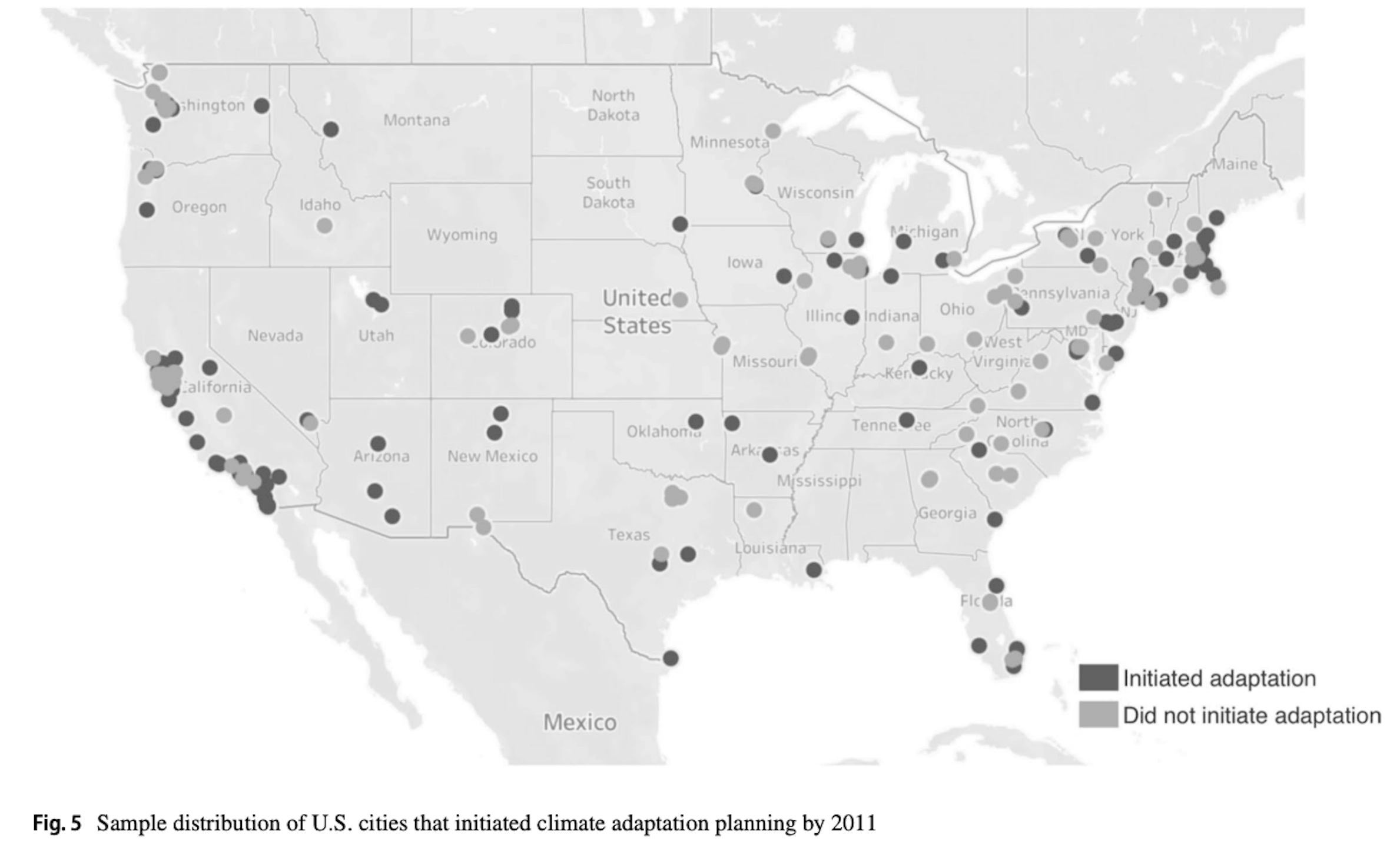
By 2021, 98 out of 230 US cities (42.61%) had published at least one plan addressing climate adaptation – whether standalone or integrated – marking their transition from informal discussions to policy formulation. Meanwhile, 128 cities (55.65%) had initiated adaptation activities as early as 2011.
Statistical analysis via binary logistic regression demonstrated that public officials’ perception of increasing climate hazards strongly motivated initial action. For each additional hazard identified, the likelihood of a city initiating adaptation increased by 14%. Access to external funding and previous adaptation experience were also powerful predictors, increasing the odds by 270% and 272%, respectively.
Conversely, advancing to the stage of publishing a plan was more strongly influenced by citizen perception of climate risk and sustained involvement in learning networks. For every 1% increase in residents who believed climate change would moderately or greatly harm the U.S.A., the probability of publishing a plan rose by 15%. Additionally, cities that remained members of ICLEI from 2011 to 2021 had a 144% higher likelihood of developing an adaptation plan. Motivation-related variables such as leadership commitment were statistically relevant only for initial engagement, not for long-term advancement.
A closer look at the geographical distribution of results reveals marked disparities. California led the way, with 53 cities responding to the 2011 survey and 30 cities (56.6%) publishing adaptation plans by 2021. New York followed with 23 surveyed cities, of which 13 (56.5%) advanced to the planning stage. Massachusetts, with 12 participating cities, saw 7 (58.3%) develop plans. Florida, with 10 cities surveyed, had 5 (50%) publish a plan. These states show relatively high engagement, reflecting both political will and resource availability.
In contrast, several states lagged significantly. Among the 45 states represented, states such as Mississippi, North Dakota, South Dakota, and West Virginia had 1 to 2 cities included in the survey, none of which had published a plan by 2021.
In the U.S.A., climate adaptation emerged as a grassroots movement led by local governments, often without federal guidance. Early efforts focused on identifying vulnerabilities and initiating discussions. Yet, the progression from awareness to formal planning has been slow.
Climate adaptation fits within the broader framework of urban innovation – new policy domains that address emergent urban challenges. According to the literature, four dimensions drive innovation: perceived need, motivation, learning networks, and resources. The study applies these principles to understand the differing factors behind the initiation and advancement of climate adaptation.
Notably, the study introduces a novel dual-stage perspective by mapping climate adaptation onto Rogers’ innovation-decision model and the public policy process. The first stage (agenda-setting) involves recognizing the need for adaptation, while the second (policy formulation) involves crafting actionable plans.
Differentiating these phases allows for a more nuanced understanding of urban policy innovation and highlights the necessity of tailored interventions.
This longitudinal study utilizes data from the 2011 MIT-ICLEI Survey, which assessed climate adaptation planning across 230 U.S.A. cities, representing 45 states. To analyze cities’ progression over a decade, the survey data was supplemented with secondary sources, including the U.S.A. Census, FEMA’s National Risk Index, Yale Climate Opinion Maps, and local government documentation. By December 2021, cities were evaluated on whether they had published standalone or integrated adaptation plans.
Binary logistic regression models were employed to determine the significance of 17 independent variables categorized under the four innovation drivers: need, motivation, learning networks, and resources. Model 1 assessed factors influencing the initiation of adaptation (based on 2011 survey responses), while Model 2 evaluated determinants of advancement (measured by published plans as of 2021).
The analysis revealed no overlap in significant variables between the two models, underscoring that initial engagement and continued policy development are driven by distinct forces. For example, public officials’ perception of risk and access to external funding catalyze initiation, while citizen awareness and institutional embeddedness in networks support advancement.
